
PROFILES 2023
To better align to the competency paradigm at the core of PROFILES, SMIFK/CIMS decided to rename the second edition of PROFILES as "Principal Relevant Outcomes For Integrative Learning and Education in Switzerland".
PROFILES outline the medical competencies that graduates in Switzerland must demonstrate when entering residency. It is rooted in a competency-based approach to medical education, which focuses on the outcome of a profession-oriented curriculum. Thereby, it aims to develop competencies “in daily practice for the benefit of the individual and the community being served”, according to Epstein and Hundert (2002)[1].
To reach this goal, competencies must integrate basic and clinical knowledge and their scientific foundation, skills, values and attitudes essential for medical practice for each age group, all set of circumstances (prevention, acute, chronic and palliative care, rehabilitation) and each setting (ambulatory, hospital, long-term and community care).
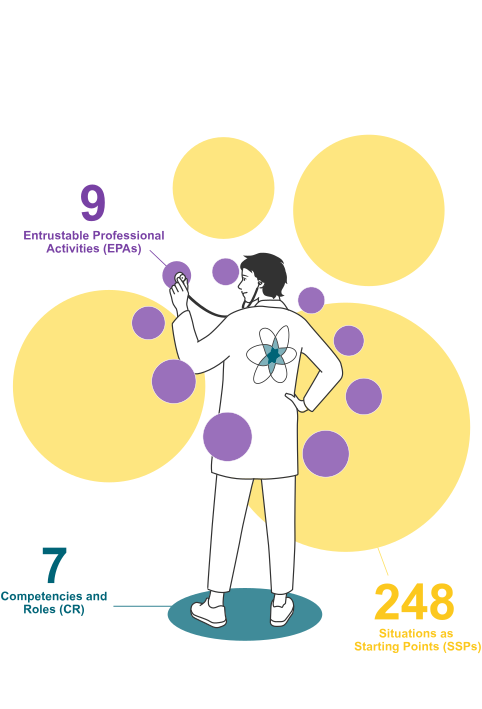
The three main chapters of PROFILES cover three inseparable pillars of medical actions: CanMEDS roles (CRs), Entrustable Professional Activities (EPAs) and Situations as Starting Points for Learning (SSPs). These three pillars interact the following way: CanMEDS roles define the personal attributes and competencies of the graduate. Entrustable Professional Activities represent what the graduate is expected to perform (by using the competencies), and Situations as Starting Points for Learning list the situations in which these professional activities are to be rendered. Ultimately, competencies are observable through EPAs performed for a given SSP.
PROFILES operationalizes the objectives set by the University Medical Professions Act.[2] The document is intended for medical students, medical teachers, and curriculum developers. It offers a comprehensive orientation on the expected competencies graduates should demonstrate at the start of their postgraduate training. Moreover, the Ordinance on the Federal Examinations for the University Medical Professions declares that PROFILES determine the content of the Federal Licensing Examination (FLE). PROFILES also offer an orientational framework for the accreditation of the curricula by Swiss faculties of medicine.
It must be emphasized that although PROFILES do not provide an explicit and comprehensive list of discipline-related knowledge, the acquisition of this knowledge (both fundamental and clinical) constitutes an essential prerequisite for any medical competency and activity, especially in the area of clinical reasoning.
The new set of PROFILES account for the evolution of medicine and society as well as three relevant, recent, global developments. They integrate aspects of diversity, identity, and gender medicine, distributed across all three chapters. The updates also address digitalization in medicine, and new technological advances like clinical decision support systems and artificial intelligence. In addition, “sustainable health care" has been integrated into various positions, with the understanding that it provides high-quality care while preserving the environment, is affordable now and in the future, and has a positive social impact. The sustainability of the health system based on the recognition that human health depends on the integrity of ecosystems, with a broader focus on creating health at the population level. It also reflects an adequate interprofessional activity and task-sharing to optimally use available resources. Finally, EPA 9 has been rewritten to present relevant instruments and measures for patient safety and creating observable situations for feedback and assessment.
[1] Epstein RM, Hundert EM. Defining and assessing professional competence. JAMA. 2002 Jan 9;287(2):226-35. DOI: 10.1001/jama.287.2.226. PMID: 11779266.
[2] https://www.fedlex.admin.ch/eli/cc/2007/537/fr
https://www.fedlex.admin.ch/eli/cc/2007/537/de
https://www.fedlex.admin.ch/eli/cc/2007/537/it