
Entrustable Professional Activities (EPAs)
An Entrustable Professional Activity (EPA) is a unit of medical activities that a trainee is entrusted to perform once the trainee has demonstrated sufficient competence in the activities. Entrustability is closely related to the trainee’s level of autonomy in the given task and the need for supervision. Although new graduates still require direct supervision in several situations, they have to deal with tasks that they must perform under distant supervision.
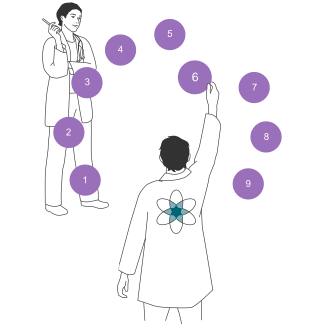
The medical activities that graduates are expected to perform at the level of distant supervision on the first day of their residency are outlined in nine common and general EPAs.
Obtain a complete and accurate history in an organized fashion, taking into account the patient’s expectations, priorities, values, beliefs and spiritual needs; explore complaints and situations in persons of all ages; adapt to linguistic skills and health literacy; respect confidentiality
Explore patient expectations, values and priorities
Use patient-centered, hypothesis-driven interview skills; be attentive to patients' verbal and nonverbal cues, patient/family culture, concepts of illness; check need for interpreting services; approach patients holistically in an empathetic and non-judgmental manner
Evaluate understanding and decision-making capacity of all patients, especially those of psychiatric patients, cognitively impaired persons or minors
Identify and use alternate sources of information to obtain history when needed, including but not limited to family members, primary care physicians, staff of care and living facilities, pharmacy or social/health alliance
Assess gender, social, cultural and other factors that may influence the patient’s perception and description of symptoms; demonstrate cultural awareness and humility, and be conscious of the potential for bias in interactions with the patient
In cases of long-term follow-up care, select the most salient issues that must be addressed in terms of treatment, side-effects, compliance, daily impact of the disease and patient’s environment
Review the patient’s health behavior, lifestyle, and environmental risk exposure as part of a routine check-up, or as far as possible, and assess the patient’s opinions, representations and expectations
Explore the patient’s use of medicine and treatment, including complementary and integrative medicine
Explore the patient’s use or misuse of psychoactive substances
Use clinical reasoning in gathering focused information relevant to a patient’s care
Identify issues not mentioned spontaneously by the patient (hidden agenda)
Recognize situations involving potential self-harm or victimization, such as interpersonal violence, assault
Specific competencies / skills related to history taking
Take an age-specific pediatric history (involving mother/father and child or adolescent)
Perform an age-specific assessment of a child’s / adolescent’s development and lifestyle
Take a psychiatric history
Take an occupational and workplace history, consider ergonomic and hygienic situation
Take a sleep history
Take a history of sexual and reproductive health
Take a history from critically ill or dying patients
Perform an accurate and clinically relevant physical examination in a logical and fluid sequence, with a focus on the purpose and the patient’s expectations, complaints and symptoms, in persons of all ages; respect patient privacy, comfort, and safety
Assess the cognitive and mental state of the patient including attention, memory, perception, understanding, language, expression, affect, and behavior
Perform a physical examination in difficult situations such as obesity, invasive procedure, non-cooperative patients, reduced consciousness, cognitive impairment, disabled patients, and persons who do not speak the local language or are of different ethnicity
Identify, describe, document and interpret abnormal findings of a physical examination. Assess vital signs (temperature, heart and respiratory rate, blood pressure)
Demonstrate patient-centered examination techniques; demonstrate effective use of devices, as recommended by medical societies (such as a stethoscope, otoscope, ophthalmoscope)
Explain physical examination maneuvers, obtain consent as appropriate, and communicate findings
Recognize the signs of imminent death
Specific competencies / skills related to history taking. Students are expected to perform the tasks below on simulated or real patients. However in some situations, in italics, only a demonstration of the technique should be expected
Assessment of patient’s general condition and vital signs
Assessment of nutritional status
Assessment of state of consciousness, attention, orientation, language/speech, affect, mood
Evaluation of patient’s decision-making capacity
Assessment of the skin, hair and nails, description of lesions
Palpation of lymph nodes
Inspection and palpation of the orbit, eyelids and eye (all structures)
Assessment of visual acuity and visual field, as well as optic disc and retinal vessels with ophthalmoscope
Assessment of color vision
Assessment of eye movements, recognition and description of nystagmus
Inspection and palpation of auricle and adjacent region as well as external auditory canal and tympanic membrane (using otoscope) - hearing tests with whispering, conversational voice and tuning fork
Examination of nose, face, mouth, salivary glands, pharynx, larynx, and neck visually, manually, and by using basic, non-endoscopic instruments
Inspection, palpation and auscultation of cervical structures
Inspection and palpation of thyroid, carotid arteries
Inspection and palpation of skeleton and joints
Functional testing of joint mobility: shoulders, elbows, wrists, hands, fingers, hips, knees, ankles, feet, and toes
Inspection, palpation, percussion and assessment of mobility of the spine
Inspection and palpation of chest, percussion and auscultation of lungs
Palpation (apex beat/fremitus) and auscultation of heart; description of normal/abnormal heartbeat and murmurs
Palpation of pulse, testing for arterial insufficiency or bruits
Demonstrate ability to perform simple ultrasound investigations (suspected pleural effusion, abdominal mass, ascites)
Assessment of venous system
Palpation, percussion and auscultation of abdomen, description of findings
Inspection and palpation of groin / hernial orifices
Examination of external genitals (all sexes)
Rectal examination in patients of all sexes (anus, rectum, prostate gland, sacrum, vagina, uterus, parametria)
Speculum examination: inspection of vagina and cervix
Bimanual examination: vagina, cervix, uterine corpus, ovaries
Palpation of breast
Neurological examination: Assessment of state of consciousness, attention, orientation, language/speech, cranial nerves, motor system (including involuntary movements), sensory system, reflexes, stand and gait
Assessment of coma (scale)
Examination of new-borns (Apgar score, dysmorphism, malformation)
Assessment of age-specific anthropometric characteristics of infants / children / adolescents
Assessment of pubertal growth (pubertal stages)
Age-specific assessment of the child: neurological and cognitive development
Assessment of basic and instrumental activities of daily living
Forensic examination of persons under the influence of alcohol and/or drugs
Approach to and documentation of physical/sexual violence
Clinical diagnosis of death, estimation of time of death
Synthesize essential data from previous records, integrate the information derived from history, meaningful physical and mental symptoms and physical exam; provide initial diagnostic evaluations; take into account the age, gender and psychosocial context of the patient as well as social determinants of health
Assess the degree of urgency of any complaint, symptom or situation
Demonstrate awareness of polymorbidity and atypical presentation of disease, especially in elderly patients
Integrate the scientific foundations of basic medical sciences as well as epidemiological information (probability of diseases) into clinical reasoning, in order to develop a differential diagnosis and a working diagnosis, organized in a meaningful hierarchical way
Engage with supervisors and team members for review and confirmation of the working diagnosis; explain and document the clinical reasoning that led to the working diagnosis; demonstrate critical thinking with regard to differential diagnosis
Manage ambiguity in a differential diagnosis for oneself and the patient; respond openly to questions from patients and members of the healthcare team; continuously update differential diagnosis
Recommend first-line, cost-effective diagnostic evaluation for a patient with an acute or chronic disorder or as part of routine health maintenance
Justify an informed, evidence-based rationale for ordering tests (when appropriate, based on integration of basic medical disciplines as they relate to the clinical condition); take into account cost-effectiveness and environmental impact of test ordering
Obtain informed consent: discuss with the patient and the family or proxy, and ensure that they understand the indications, risks, benefits, alternatives, and potential complications; seek an agreement/shared decision and document it in the file
Demonstrate awareness of differences in values and thresholds regarding sex and age in the interpretation of biological test results: use reference values
Interpret results of tests and investigations (including morphological and pathological findings) and integrate them into the differential diagnosis; understand the implications and urgency of an abnormal result and seek assistance with interpretation if needed
As part of a routine check-up, advise patients and order screening tests or procedures to identify asymptomatic diseases or risk factors, weighing up their risks, benefits and predictive value; apply valid epidemiological data in selecting tests and procedures
Provide an informed rationale for ordering imaging examinations; interpret first-line, common X-rays; integrate diagnostic imaging into the clinical workup
Order required tests and investigations in situations with medicolegal implications: substances in the blood, X-rays and genetic tests
Understand and explain the anatomy and physiology, indications and contraindications, risks and benefits, alternatives and potential complications of the procedure
Obtain informed consent: communicate the information to the patient and the family or proxy, seek an agreed/shared decision and document it in the medical record
Demonstrate the technical (motor) skills required for the procedure
Observe principles of asepsis and maximize patient safety during procedure
Manage common post-procedure complications
Specific procedures that must be mastered by the student by the end of the curriculum. Students are expected to perform the procedures below with real patients, except for some specific procedures that should be learnt and performed as simulations (marked with italics)
Measuring and interpreting body temperature
Intravenous injection and cannulation, subcutaneous and intramuscular injection
Insertion of a peripheral intravenous line, planning and managing parenteral administration of drugs
Pre-operative preparation of surgical field for minor surgery; asepsis and antisepsis
Local skin anesthesia
Wound cleaning, application and removal of sutures
Application of bandages and dressings
Basic spirometry, measurement of peak expiratory flow
Arterial puncture for blood gas analysis
Instruction of the patient in the use of metered dose inhalers, spacers and nebulizers
Taking a throat swab and performing a rapid streptococcal test
Ear irrigation
Removal of a superficial foreign body from the cornea
Urethral catheterization
Performance and interpretation of a urine stick test
Preparation and examination of urinary sediment
Performance and interpretation of an ECG
Performance and interpretation of a pregnancy test
Assisting in the delivery of a baby
Clamping of umbilical cord / separating placenta from child
Nasogastric intubation
Lumbar puncture
Cutaneous allergy test (Prick-test)
Recognize abnormal vital signs
Interpret the clinical situation using pathophysiological principles
Assess the urgency and the severity of a patient’s situation / illness and indications for escalating care
Identify possible underlying etiologies of the patient’s deteriorating condition
Initiate a care plan for the decompensating patient; apply basic and advanced life support as needed
Take into account a “do-not-resuscitate” request
As a team member, share vital and relevant information with other members, using structured communication techniques as well as briefings and debriefings for continuing decision-making and follow-up of the patient
Identify the need for rapid transfer of a patient to another facility
Update the patient/family and ensure that they understand the indications, risks and benefits, alternatives and potential complications. If possible, ask for the patient’s informed consent and check for any advance directives
Emergency situations that any resident can autonomously and trustworthily initially manage, i.e. assess the patient’s state, order and interpret tests, initiate first procedures and treatment, included basic, immediate, and advanced life support:
Transient loss of consciousness, syncope, coma, seizures
Shock, severe hypotension
Acute chest pain
Acute severe headache, meningism
Acute abdominal pain
Sudden deterioration of mental state, e.g. confusion / delusion /(auto-)aggressive behavior
Shortness of breath
Severe hypertension
Uncomplicated trauma such as fall, minor traffic injury
Acute neurological deficits
Severe acute blood loss
Intoxication / poisoning
Burns
Establish a management plan that integrates information gathered from history, physical examination, laboratory tests and imaging as well as the patient’s preference; incorporate the prescription of medications, physiotherapy and rehabilitation, dietetic and lifestyle advice, psychological support, social and environmental measures into the management plan
Use clinical scores and clinical decision rules/protocols to support decision-making (Bayesian approach) when appropriate
Adopt a shared-decision making approach in establishing the management plan, take into account patient's preferences in making orders; take into account an indication or request for complementary and integrative medicine; deal with treatment refusal; demonstrate an understanding of the patient’s and family’s current situation, beliefs and wishes, and consider any physical dependence or cognitive disorders; react appropriately when the patient lacks autonomous decision-making capacity
Take into account the patient’s specific profile and situation, such as gender, age, culture, religion, beliefs and health literacy; take into account the vulnerability of specific groups such as immigrants, patients with low socioeconomic status, adolescents
Ensure patient’s and family’s understanding of the indications, risks and benefits, alternatives and potential complications of treatment
Understand and apply the concept and basic elements of advance care planning
Demonstrate an insight into emotional factors that can interfere with patient-doctor communication and their management
Provide effective treatment (non-pharmacological, pharmacological, and interventional) of all types of pain
Prescribe antibiotics only with clear indications and be aware of the issue of antibiotic resistance
Avoid unnecessary/futile/low-value diagnostic measures and treatment (smarter medicine)
Determine prescription and treatment according to the patient’s condition, and adjust for weight, allergies, pharmacokinetics, pharmacogenetics (“precision medicine”), potential interactions with other medication and substances, pregnancy status or co-morbid conditions, legal/illegal psychoactive substances, potential for self-harm. Use therapeutic drug monitoring appropriately.
In patients with multimorbidity, prioritize measures and medication; compose orders efficiently and effectively, whether in oral, written or electronic format
During follow-up, support self-management by the patient; evaluate and discuss adherence; discuss the potential impact of non-adherence if needed, especially with patients who are cognitively impaired or unable to make decisions; use motivational approaches if appropriate
Ensure continuity and interprofessional collaboration in caring for chronic and polymorbid patients
Counsel patient and family proactively on decision-making at the end of life, taking into account the patient’s preferences and acceptable outcomes; involve a chaplain if needed and/or consult with ethicist in difficult situations
Prescribe measures for treatment of pain, palliative and end-of-life care, taking into account any advance directives or a “do not resuscitate” request
Document and record the patient’s chart; filter, organize, prioritize and synthesize information; comply with requirements and regulations
Document and record the patient’s autonomous decision-making capacity
Document the rationale for the clinical decision and for involving the patient in making the decision; provide and incorporate discharge document
Document the discussion and the informed consent appropriately in the health record, taking into account the importance of privacy, confidentiality and data protection, especially in the use of electronic communication and records
Provide an accurate, concise, relevant, and well-organized oral presentation of a patient encounter and situation, adjusting it to the profile and role of the recipient; elicit feedback about the handover, especially when assuming responsibility for the patients; ask for clarification if needed
Organize transfer of a patient from one setting to another, involving the patient and family/caregivers; at discharge from hospital, identify the needs for (sustainable) assistance by psychosocial network
Consider forced hospitalization for acute psychiatric breakdown
Identify actual and potential (“near miss”) errors in a patient encounter and report them using an error reporting system (CIRS). Show adequate accountability
Address and question critical aspects in patient safety, involving other team members
Report own errors to a superior and provide a plan for improvement
Encourage patients as partners and communicate sufficient information to patients and families to enable self-care, shared decision-making, and error detection
Check drug prescriptions with regards to safety and interactions, considering safety/quality procedures and their vulnerabilities
Apply validated standard operating procedures (SOPs) in risk prone clinical situations (e.g. for minimizing nosocomial infections and resistance to antibiotics, avoiding unnecessary investigations and treatments by using 'smarter medicine', optimizing communication during transition of care)
Contribute to the literacy of patients regarding environmental and ecological safety
Assess patient-specific environmental risks and propose safety measures (i.e. fall risk in elderly, self-medication)